


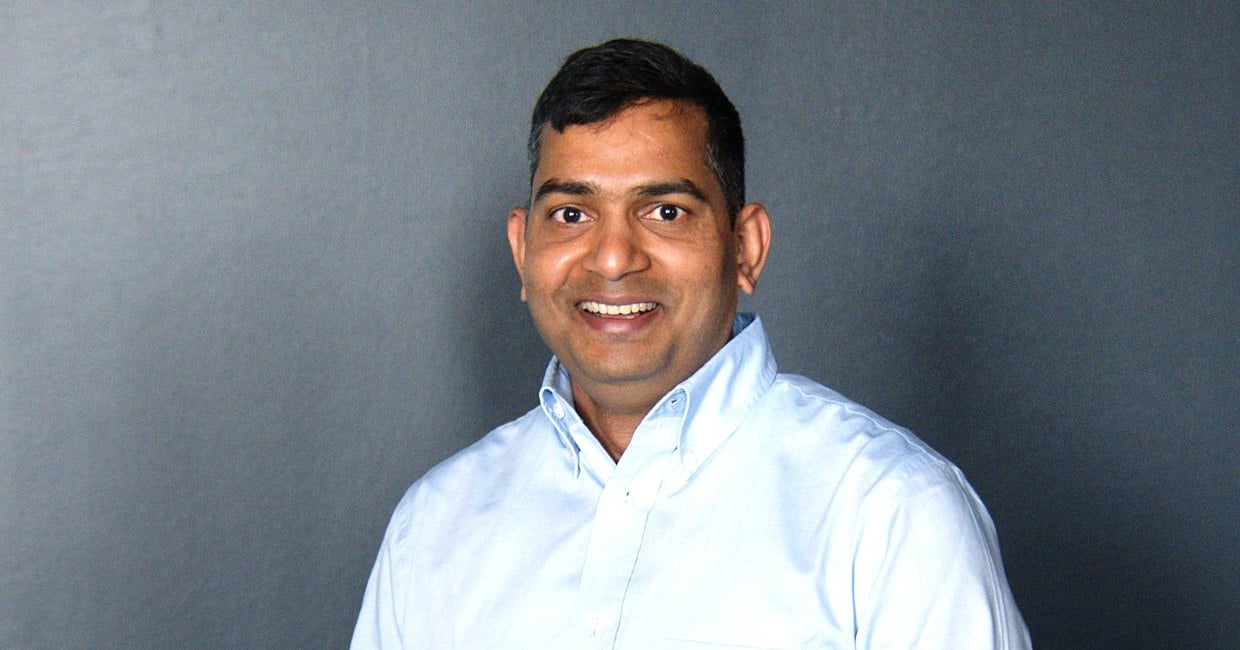
Santoshkumar Patel: Using AI to transform how automated terminals are designed
Key takeaways
- Santoshkumar Patel has spent 15 years at Kalmar and for the last five years has been helping customers validate automation and electrification concepts as part of terminal design services.
- Kalmar's emulation approach uses the same production software and real operational data as live terminals, allowing customers to get answers to critical questions such as fleet size, charger locations and productivity impact already early on.
- AI has significantly transformed both the speed and depth of this work, reducing terminal configuration time and enabling more complex analyses — ultimately supporting more data-driven decision-making for customers.
Santoshkumar Patel, Senior Product Engineer in Automation Product Management team, leads emulation work as part of terminal design services, helping our customers to evaluate and optimize automation and electrification concepts before implementation.
Having been with Kalmar for 15 years, Santoshkumar’s journey reflects the evolution of terminal automation itself. With earlier automation projects, operational improvements were often identified through trial and error in live operations. Now, customers can explore scenarios, test assumptions, and refine their terminal design before committing to a specific setup.
Emulation has come a long way over the past decade, and AI is now further transforming how the work is done. Santoshkumar has been at the forefront of experimenting with AI tools and understanding what value they can bring to emulation and terminal design.
Seeing the evolution of terminal automation
Santoshkumar’s story with Kalmar began in 2011, when he joined as a software developer. "Initially, I started as a software developer in India and later moved to Finland to work on the first automation projects," he recalls. His career took a transformative turn when he spent around five years in Los Angeles at the TraPac terminal, Kalmar's first automated terminal in North America.
"It was amazing to see the machines running and executing the programs we had built. When I saw the first container movements, I could hardly believe it was actually possible," Santosh shares. Watching software come to life in real terminal operations broadened his perspective, and learnings from that experience continue to support his work still today.
It was amazing to see the machines running and executing the programs we had built. When I saw the first container movements, I could hardly believe it was actually possible
After returning to Finland, Santosh moved into product management. For the past five years, he has been running emulation projects for customers around the world. In practice, this means helping customers visualize, test, and better understand how their terminal could operate in the future.
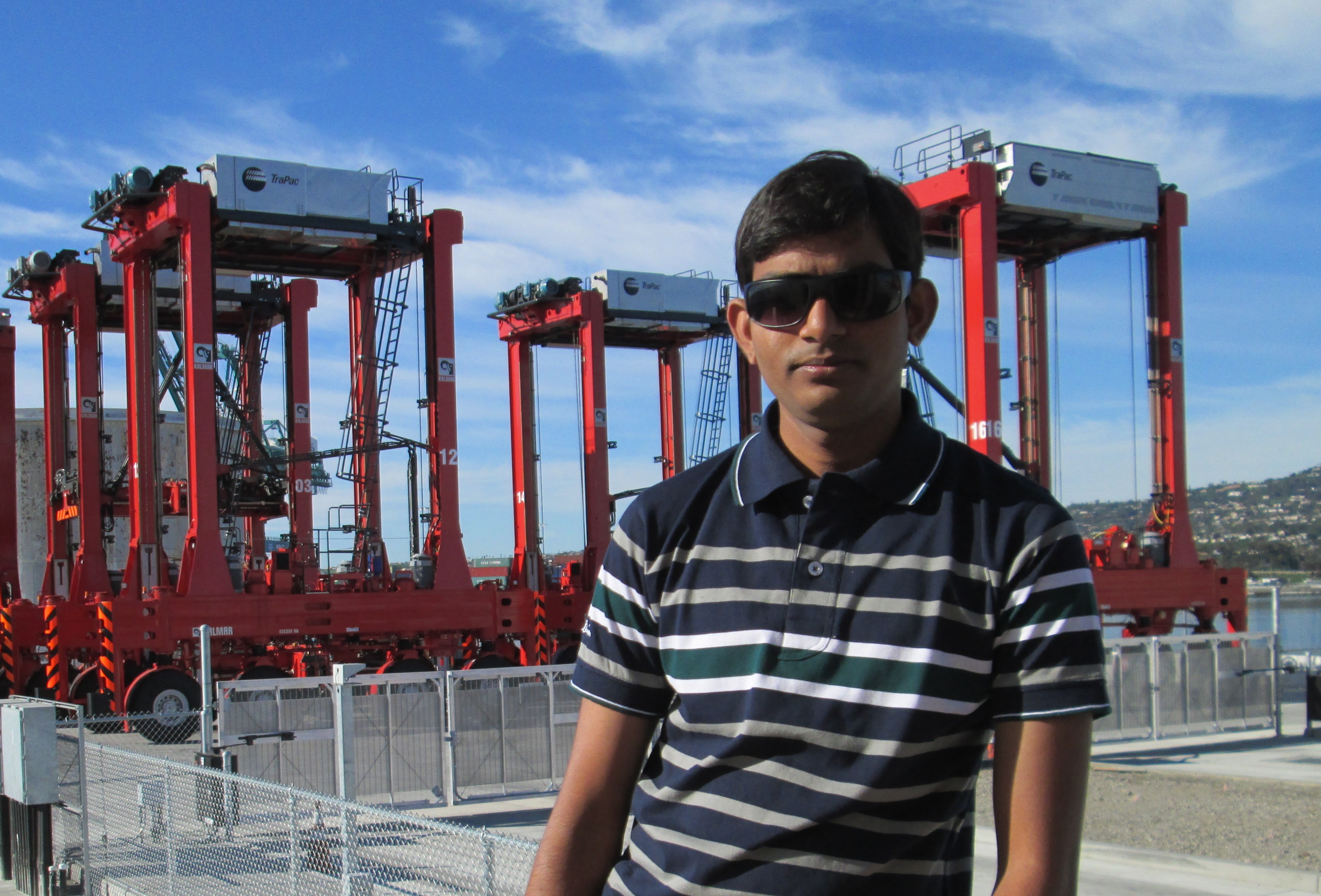
Santoshkumar Patel at Trapac terminal, Los Angeles in 2012.
Making the future visible through emulation
The process begins with terminal design and layout, followed by building a full digital emulation of the operations. What makes the emulation approach particularly valuable is its foundation in production software. “We utilize all the same components that are used in production,” Santosh notes. “We parameterize our simulators based on real data, like driving speed and curve speed, so they behave like real machines," he adds. The insights from these emulations help our customers to make informed business decisions concerning their future operations.
We parameterize our simulators based on real data, like driving speed and curve speed, so they behave like real machines
For electrification projects, emulation provides concrete answers to many operational questions: How many straddle carriers are actually needed? How many charging stations, and where should they be located? What's the impact on productivity? "For electrification, operators would know for example how many machines are required, how many charging stations, and where those should be located. We analyze productivity, traffic patterns, and other operational data so our customers can make a business decision based on those insights," Santoshkumar explains.
As automation and electrification projects have grown in scale and complexity, this ability to test and validate designs before implementation has become increasingly critical for de-risking major investments.
Different scenarios for terminal’s future
The true value becomes especially clear when customers begin exploring different scenarios. “Our customers are often really excited to see the emulations, because they’re looking at the future of their terminal,” he says. Through emulation, operators can test scenarios in advance: What happens if a machine breaks down? How do operations perform during disruptions? What's the optimal balance between different equipment types?
Our customers are often really excited to see the emulations, because they’re looking at the future of their terminal
By testing multiple scenarios before implementing them in real life, customers can evaluate different setups and determine how best to reach their operational targets. “One customer ran more than a thousand emulations and revised their plan several times after realizing that certain station locations weren’t feasible,” Santosh explains. Emulation allows these kinds of challenges to be identified and resolved early on, without the cost and risk of making changes in a live terminal environment.
This ability to test and refine solutions before implementation represents a major shift from earlier automation projects. “With earlier automation projects we didn’t have this luxury,” Santosh recalls. “We had to deploy the software first and only then realize that something wasn’t working properly, which could disrupt operations. Now we are able to test basically everything in advance.”
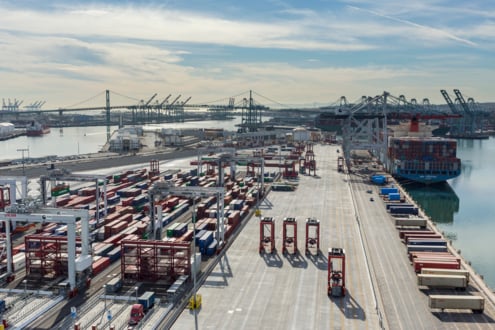
Trapac Los Angeles terminal back in 2015.
AI changing the game
What's transformed Santosh's work most recently is the integration of AI tools into his daily work. "AI supports my work from configuring the terminal to all the way to analysis. Earlier, configurations took two to three months; now it can be done in a couple of days," Santosh explains. "I can write scripts with the support of AI to generate configurations for charging stations, machines, and vessels.”
But the impact goes beyond speed. AI removes barriers to complex analysis that were previously too time-consuming to pursue. "Earlier, writing scripts for complex data plotting or traffic patterns was so time-consuming it was limiting what was possible. Now, I am able to take the analysis further with AI because it's just a few prompts away," he says.
Now, I am able to take the analysis further with AI because it's just a few prompts away
In practice this means our customers benefit from deeper insights and analysis in a shorter period of time, all contributing to better-informed investment decisions.
What makes it meaningful
When asked why his work matters, Santosh focuses on the value of foresight. "My work gives our customers information well ahead of time about the problems they might face in real operations," he says. Seeing the contrast with earlier projects makes this especially meaningful as nowadays we are able to help our customers lower the risk of their investments and better support them in finding the right solutions to their specific operations.
My work gives our customers information well ahead of time about the problems they might face in real operations

Related articles
Further reading
Subscribe and receive updates in your email
Prenumerera på våra publikationer